ACADEMICS [ PCM | PCB ] Class 11-12th | IIT-JEE | NEET | CUET 2026 | COMPETITIVE EXAMS

Informatics Practices Tuition Class 12th
1. Prerequisites
Informatics Practices Class-XI
2. Learning Outcomes
At the end of this course, students will be able to:
● Create Series, Data frames and apply various operations.
● Visualize data using relevant graphs.
● Design SQL queries using aggregate functions.
● Import/Export data between SQL database and Pandas.
● Learn terminology related to networking and internet.
● Identify internet security issues and configure browser settings.
● Understand the impact of technology on society including gender and disability issues.
Pattern of Studies
● Interactive Classes
● Home Assignments
● Class Notes
● Periodic Class Tests
● Student's Monthly Report
● One to One Attention
● Doubt Classes
● Syllabus Revision
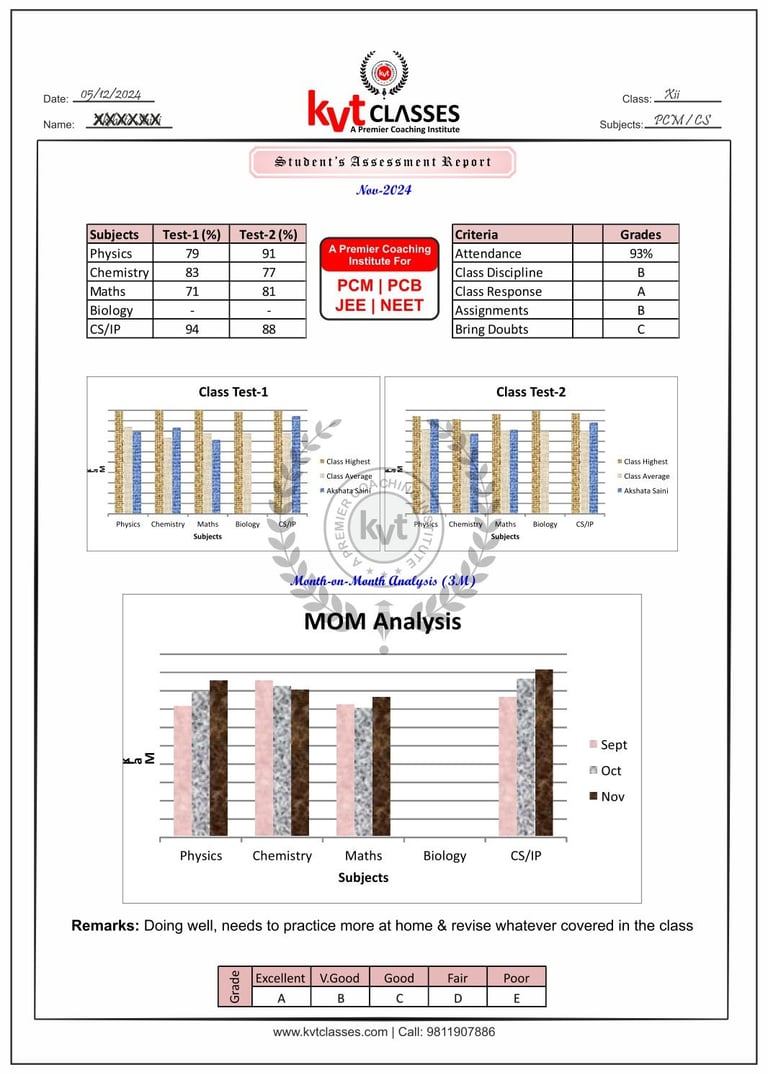
Report Analysis Parameters
● Tests Marks
● Attendance
● Class Discipline
● Class Response
● Home Assignments
● Student's Comparison with Class
● Last 3 Months Performance
● Special Remarks
Student's Sample Report
Class Tests
● Two tests per subject in a month
● Test schedule on Saturday in extra hours
● Result within 1 week of test conduct
● Test discussion on result day
● Mistakes rectification briefing
Informatics Practices Tuition Class 12 introduces students to programming, problem-solving, algorithms, Python basics, data handling, and logical thinking. However, many students find coding and technical concepts difficult at first. Therefore, proper guidance and regular practice become essential. At KVT Classes, every topic is explained step-by-step so students can learn with confidence and clarity.
Why choose KVT Classes for Informatics Practices Tuition Class 12
Experienced and qualified faculty
CBSE syllabus-based teaching
Regular coding practice sessions
Personalized doubt-solving support
Weekly tests and performance analysis
Easy-to-understand study material
Focus on conceptual and practical learning
Student-friendly classroom environment
Conduct of Classes
● On board explanation with notes
● Make Concept clear with practical examples
● Interactive class sessions
● Home work / Assignment at the end of the class
● Home work / Assignment check in the next class
● Quick recap of previous class in the next class
● Two tests per month/subject on Saturdays
● Class duration 1 Hr/sub alternate days (3Hrs./wk)
● Extra classes provided when needed
Classes Schedule 2025-26
Science Students Class XI-XII
Note: Class Tests will be conducted on Saturday in extra hours
Syllabus & Marks Weightage [ Class-XII ]
Detailed Syllabus [ Class-XII ]
Unit 1: Data Handling using Pandas -I
Introduction to Python libraries- Pandas, Matplotlib.
Data structures in Pandas - Series and Data Frames.
Series: Creation of Series from – ndarray, dictionary, scalar value; mathematical operations; Head and Tail functions; Selection, Indexing and Slicing.
Data Frames: creation - from dictionary of Series, list of dictionaries, Text/CSV files; display; iteration; Operations on rows and columns: add, select, delete, rename; Head and Tail functions; Indexing using Labels, Boolean Indexing;
Importing/Exporting Data between CSV files and Data Frames.
Data Visualization
Purpose of plotting; drawing and saving following types of plots using Matplotlib – line plot, bar graph, histogram
Customizing plots: adding label, title, and legend in plots.
Unit 2: Database Query using SQL
Revision of database concepts and SQL commands covered in class XI
Math functions: POWER (), ROUND (), MOD ().
Text functions: UCASE ()/ UPPER (), LCASE ()/ LOWER (), MID ()/ SUBSTRING () /SUBSTR (), LENGTH (), LEFT (), RIGHT (), INSTR (), LTRIM (), RTRIM (), TRIM ().
Date Functions: NOW (), DATE (), MONTH (), MONTHNAME (), YEAR (), DAY (), DAYNAME ().
Aggregate Functions: MAX (), MIN (), AVG (), SUM (), COUNT (); using COUNT (*).
Querying and manipulating data using Group by, Having, Order by.
Working with two tables using equi-join
Unit 3: Introduction to Computer Networks
Introduction to networks, Types of network: PAN, LAN, MAN, WAN.
Network Devices: modem, hub, switch, repeater, router, gateway
Network Topologies: Star, Bus, Tree, Mesh.
Introduction to Internet, URL, W W W, and its applications- Web, email, Chat, VoIP.
Website: Introduction, difference between a website and webpage, static vs dynamic web page, web server and hosting of a website.
Web Browsers: Introduction, commonly used browsers, browser settings, add-ons and plug-ins, cookies.
Unit 4: Societal Impacts
Digital footprint, net and communication etiquettes, data protection, intellectual property rights (IPR), plagiarism, licensing and copyright, free and open source software (FOSS), cybercrime and cyber laws, hacking, phishing, cyber bullying, overview of Indian IT Act.
E-waste: hazards and management.
Awareness about health concerns related to the usage of technology.