ACADEMICS [ PCM | PCB ] Class 11-12th | IIT-JEE | NEET | CUET 2026 | COMPETITIVE EXAMS
Best Computer Science Tuition CBSE Board
Selecting the best Computer Science Tuition CBSE Board program is necessary for students who want to make their career in Computer Science or Artificial Intelligence (AI). Expert guidance, systematic study content and one-to-one attention is provided to all the students at KVT Classes for their academic improvement.
Class 12th is a critical level as the marks obtained in board exam would directly affect the future career prospects. Selecting a reputable coaching institute for Computer Science Tuition Class 12 help students in maintaining their focus and practical hand on making programs in python. At KVT Classes, students are given classes from well qualified and experienced faculties, which makes complex ideas easy to understand and develop problem-solving skills with ease.
Besides, the institute has a student-centered approach to teaching. Students can monitor their progress through regular doubt clearing sessions, tests and analysis of performance on a weekly basis. The learning process is very interactive & productive due to concept clarity in teaching, updated notes, revision classes and techniques of practical learning on computer.
Why choose KVT Classes for Computer Science Tuition
Experienced and qualified faculty
CBSE syllabus-based teaching
Regular coding practice sessions
Personalized doubt-solving support
Weekly tests and performance analysis
Easy-to-understand study material
Focus on conceptual and practical learning
Student-friendly classroom environment
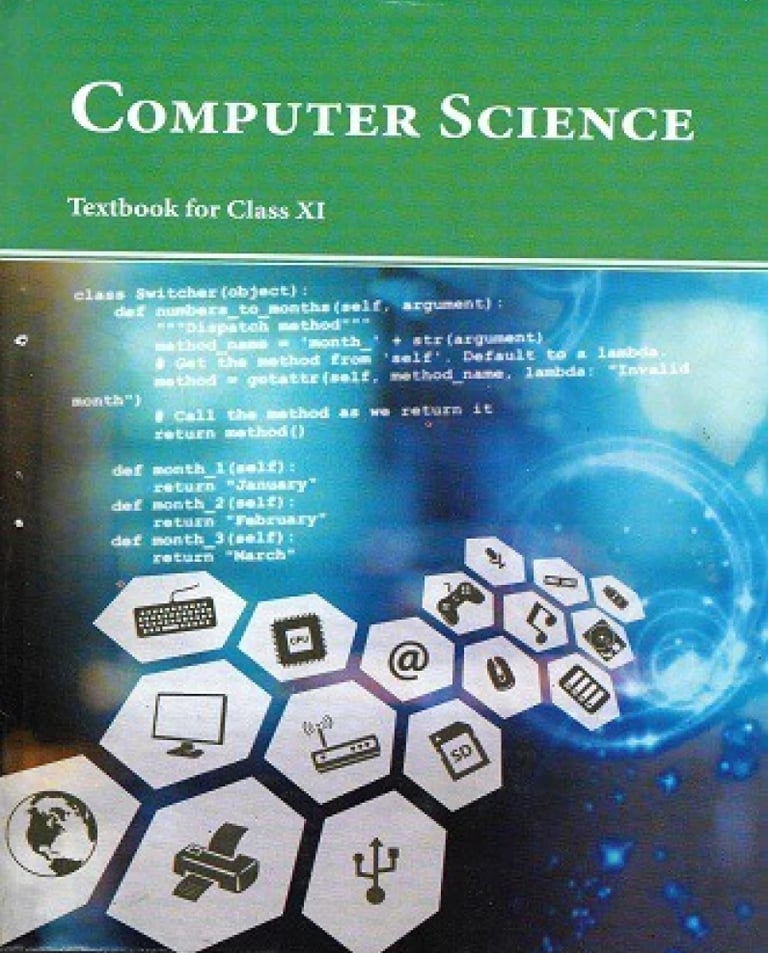
Computer Science Tuition Class 11
Learning Outcomes
Students should be able to:
a) develop basic computational thinking
b) explain and use data types
c) appreciate the notion of algorithms
d) develop a basic understanding of computer systems- architecture and operating system
e) explain cyber ethics, cyber safety, and cybercrime
f) understand the value of technology in societies along with consideration of gender and disability issues.
Pattern of Studies
● Interactive Classes
● Home Assignments
● Class Notes
● Periodic Class Tests
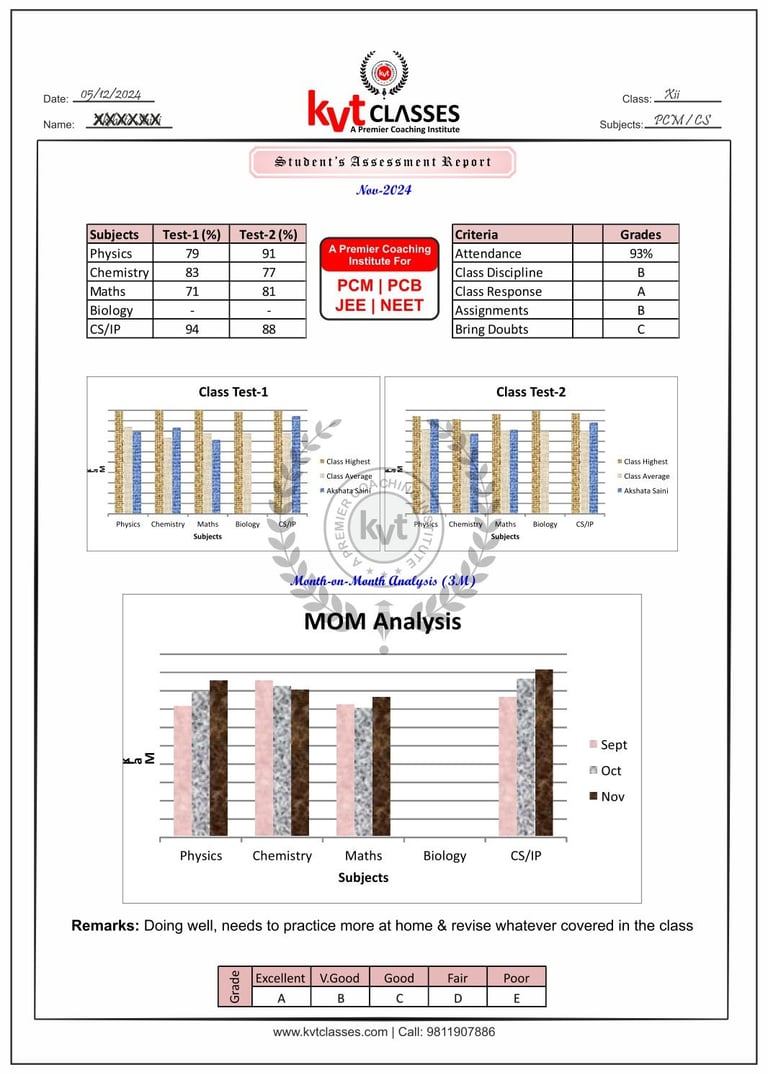
● Student's Monthly Report
● One to One Attention
● Doubt Classes
● Syllabus Revision
Report Analysis Parameters
● Tests Marks
● Attendance
● Class Discipline
● Class Response
● Home Assignments
● Student's Comparison with Class
● Last 3 Months Performance
● Special Remarks
Student's Sample Report
Class Tests
● Two tests per subject in a month
● Test schedule on Saturday in extra hours
● Result within 1 week of test conduct
● Test discussion on result day
● Mistakes rectification briefing
1. Prerequisites
Computer Science- Class XI
2. Learning Outcomes
At the end of this course, student should be able to
a) apply the concept of function.
b) explain and use the concept of file handling.
c) use basic data structure: Stacks
d) explain basics of computer networks.
e) use Database concepts, SQL along with connectivity between Python and SQL.
Computer Science Tuition Class 12
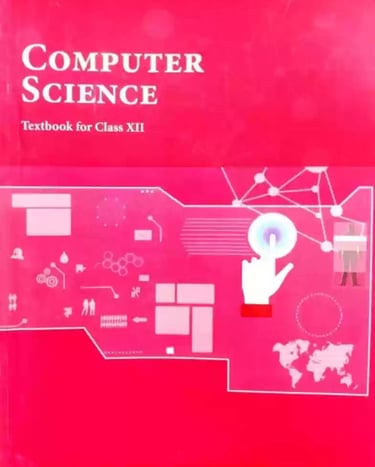
Our Computer Science Tuition Class 11 program is designed according to the latest CBSE syllabus. In addition, students receive detailed notes, coding practice sessions, assignments, and doubt-solving support. This structured approach helps learners improve both theoretical understanding and practical coding skills. Moreover, regular tests and performance tracking allow students to identify weak areas and improve continuously.
Our Computer Science Tuition Class 12 program is designed according to the latest CBSE board syllabus. In addition, students receive detailed notes, coding practice sessions, assignments, and doubt-solving support. This structured approach helps learners improve both theoretical understanding and practical coding skills. Moreover, regular tests and performance tracking allow students to identify weak areas and improve continuously.
Conduct of Classes
● On board explanation with notes
● Make Concept clear with practical examples
● Interactive class sessions
● Home work / Assignment at the end of the class
● Home work / Assignment check in the next class
● Quick recap of previous class in the next class
● Two tests per month/subject on Saturdays
● Class duration 1 Hr/sub alternate days (3Hrs./wk)
● Extra classes provided when needed
Classes Schedule 2025-26
Science Students Class XI-XII
Note: Class Tests will be conducted on Saturday in extra hours
Syllabus & Marks Weightage [ Class-XI ]
Syllabus & Marks Weightage [ Class-XII ]
Detailed Syllabus [ Class-XI ]
Unit 1: Computer Systems and Organisation
● Basic computer organisation: Introduction to Computer System, hardware, software, input device, output device, CPU, memory (primary, cache and secondary), units of memory (bit, byte, KB, MB, GB, TB, PB)
● Types of software: System software (Operating systems, system utilities, device drivers), programming tools and language translators (assembler, compiler, and interpreter), application software
● Operating System(OS): functions of the operating system, OS user interface
● Boolean logic: NOT, AND, OR, NAND, NOR, XOR, NOT, truth tables and De Morgan’s laws, Logic circuits
● Number System: Binary, Octal, Decimal and Hexadecimal number system; conversion between number systems
● Encoding Schemes: ASCII, ISCII, and Unicode (UTF8, UTF32)
Unit 2: Computational Thinking and Programming - I
● Introduction to Problem-solving: Steps for Problem-solving (Analyzing the problem, developing an algorithm, coding, testing, and debugging), representation of algorithms using flowchart and pseudocode, decomposition
● Familiarization with the basics of Python programming: Introduction to Python, Features of Python, executing a simple “hello world" program, execution modes: interactive mode and script mode, Python character set, Python tokens( keyword, identifier, literal, operator, punctuator), variables, concept of l-value and r-value, use of comments
● Knowledge of data types: Number(integer, floating point,complex), boolean, sequence(string, list, tuple), None, Mapping(dictionary), mutable and immutable data types.
● Operators: arithmetic operators, relational operators, logical operators, assignment operators, augmented assignment operators, identity operators (is, is not), membership operators (in not in)
● Expressions, statement, type conversion, and input/output: precedence of operators, expression, evaluation of an expression, type-conversion (explicit and implicit conversion), accepting data as input from the console and displaying output.
● Errors- syntax errors, logical errors, and run-time errors
● Flow of Control: introduction, use of indentation, sequential flow, conditional and iterative flow
● Conditional statements: if, if-else, if-elif-else, flowcharts, simple programs: e.g.: absolute value, sort 3 numbers and divisibility of a number.
● Iterative Statement: for loop, range(), while loop, flowcharts, break and continue statements, nested loops, suggested programs: generating pattern, summation of series, finding the factorial of a positive number, etc.
● Strings: introduction, string operations (concatenation, repetition, membership and slicing), traversing a string using loops, built-in functions/methods–len(), capitalize(), title(), lower(), upper(), count(), find(), index(), endswith(), startswith(), isalnum(), isalpha(), isdigit(), islower(), isupper(), isspace(),lstrip(), rstrip(), strip(), replace(), join(), partition(), split()
● Lists: introduction, indexing, list operations (concatenation, repetition, membership and slicing), traversing a list using loops, built-in functions/methods–len(), list(), append(), extend(), insert(), count(), index(), remove(), pop(), reverse(), sort(), sorted(), min(), max(), sum(); nested lists, suggested programs: finding the maximum, minimum, mean of numeric values stored in a list; linear search on list of numbers and counting the frequency of elements in a list.
● Tuples: introduction, indexing, tuple operations (concatenation, repetition, membership and slicing); built-in functions/methods – len(), tuple(), count(), index(), sorted(), min(), max(), sum(); tuple assignment, nested tuple; suggested programs: finding the minimum, maximum, mean of values stored in a tuple; linear search on a tuple of numbers, counting the frequency of elements in a tuple.
● Dictionary: introduction, accessing items in a dictionary using keys, mutability of a dictionary (adding a new term, modifying an existing item), traversing a dictionary, built-in functions/methods – len(), dict(), keys(), values(), items(), get(), update(), del, clear(), fromkeys(), copy(), pop(), popitem(), setdefault(), max(), min(), sorted(); Suggested programs: count the number of times a character appears in a given string using a dictionary, create a dictionary with names of employees, their salary and access them.
● Introduction to Python modules: Importing module using ‘import <module>’ and using from statement, importing math module (pi, e, sqrt(), ceil(), floor(), pow(), fabs(), sin(), cos(), tan()); random module (random(), randint(), randrange()), statistics module (mean(), median(), mode()).
Unit 3: Society, Law and Ethics
● Digital Footprints
● Digital Society and Netizen: net etiquettes, communication etiquettes, social media etiquettes
● Data Protection: Intellectual property rights (copyright, patent, trademark), violation of IPR (plagiarism, copyright infringement, trademark infringement), open source software and licensing (Creative Commons, GPL and Apache)
● Cyber Crime: definition, hacking, eavesdropping, phishing and fraud emails, ransomware, cyber trolls, cyber bullying
● Cyber safety: safely browsing the web, identity protection, confidentiality
● Malware: viruses, trojans, adware
● E-waste management: proper disposal of used electronic gadgets.
● Information Technology Act (IT Act)
● Technology and society: Gender and disability issues while teaching and using computers
Detailed Syllabus [ Class-XII ]
Unit 1: Computational Thinking and Programming – 2
● Revision of Python topics covered in Class XI.
● Functions: types of function (built-in functions, functions defined in module, user defined functions), creating user defined function, arguments and parameters, default parameters, positional parameters, function returning value(s), flow of execution, scope of a variable (global scope, local scope)
● Exception Handling: Introduction, handling exceptions using try-except-finally blocks
● Introduction to files, types of files (Text file, Binary file, CSV file), relative and absolute paths
● Text file: opening a text file, text file open modes (r, r+, w, w+, a, a+), closing a text file, opening a file using with clause, writing/appending data to a text file using write() and writelines(), reading from a text file using read(), readline() and readlines(), seek and tell methods, manipulation of data in a text file
● Binary file: basic operations on a binary file: open using file open modes (rb, rb+, wb, wb+, ab, ab+), close a binary file, import pickle module, dump() and load() method, read, write/create, search, append and update operations in a binary file
● CSV file: import csv module, open / close csv file, write into a csv file using writer(),writerow(),writerows() and read from a csv file using reader()
● Data Structure: Stack, operations on stack (push & pop), implementation of stack using list.
Unit 2: Computer Networks
● Evolution of networking: introduction to computer networks, evolution of networking (ARPANET, NSFNET, INTERNET)
● Data communication terminologies: concept of communication, components of data communication (sender,receiver, message, communication media, protocols), measuring capacity of communication media (bandwidth, data transfer rate), IP address, switching techniques (Circuit switching, Packet switching)
● Transmission media: Wired communication media (Twisted pair cable, Co-axial cable, Fiber-optic cable), Wireless media (Radio waves, Micro waves, Infrared waves)
● Network devices (Modem, Ethernet card, RJ45, Repeater, Hub, Switch, Router, Gateway, WIFI card)
● Network topologies and Network types: types of networks (PAN, LAN, MAN, WAN), networking topologies (Bus, Star, Tree)
● Network protocol: HTTP, FTP, PPP, SMTP, TCP/IP, POP3, HTTPS, TELNET, VoIP
● Introduction to web services: WWW, Hyper Text Markup Language (HTML), Extensible Markup Language (XML), domain names, URL, website, web browser, web servers, web hosting
Unit 3: Database Management
● Database concepts: introduction to database concepts and its need
● Relational data model: relation, attribute, tuple, domain, degree, cardinality, keys (candidate key, primary key, alternate key, foreign key)
● Structured Query Language: introduction, Data Definition Language and Data Manipulation Language, data type (char(n), varchar(n), int, float, date), constraints (not null, unique, primary key), create database, use database, show databases, drop database, show tables, create table, describe table, alter table (add and remove an attribute, add and remove primary key), drop table, insert, delete, select, operators (mathematical, relational and logical), aliasing, distinct clause, where clause, in, between, order by, meaning of null, is null, is not null, like, update command, delete command, aggregate functions (max, min, avg, sum, count), group by, having clause, joins: cartesian product on two tables, equi-join and natural join
● Interface of python with an SQL database: connecting SQL with Python, performing insert, update, delete queries using cursor, display data by using connect(), cursor(), execute(), commit(), fetchone(), fetchall(), rowcount, creating database connectivity applications, use of %s format specifier or format() to perform queries